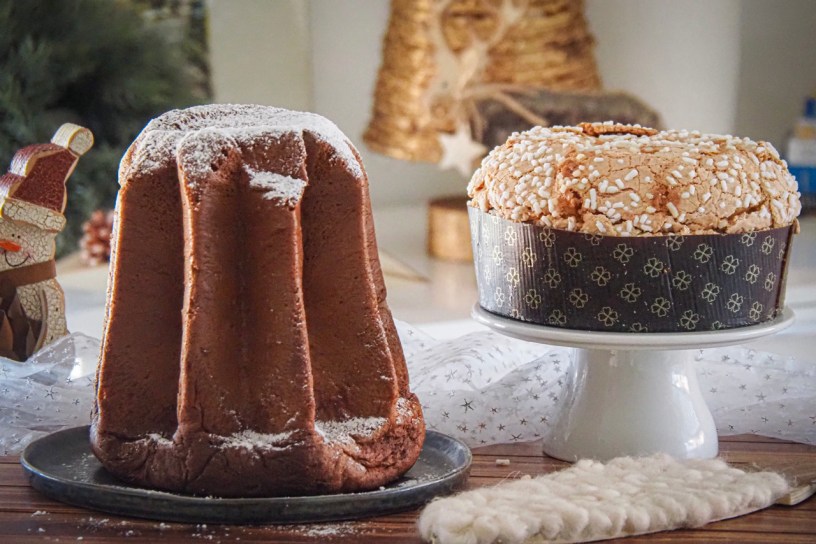
Christmas in Italy is not Christmas without panettone and pandoro. So, let my introduce you to Italy’s most popular traditional sweet Christmas breads.
It’s not Christmas in Italy without feasting on a big slice of delicious panettone or pandoro. A tradition I have safely adopted after having lived nearly ten years in Italy.
For that reason, imagine my excitement when the usual large parcel with delicious panettoni and pandori (I ordered more than one of each) arrived a few days ago. If you wonder: Yes, you can make these sweet breads at home. But it’s likely one of the trickiest, demanding, and time-consuming processes, and it needs a lot of exercise to get it right. I must confess that I’ve not yet tried to make either at home. There might come the time I will make an attempt, but for now, I am more than happy to have my trusted artisanal bakery doing the job.
If you love Italian food (and who does not), these two traditional sweet Christmas breads are a must-try.
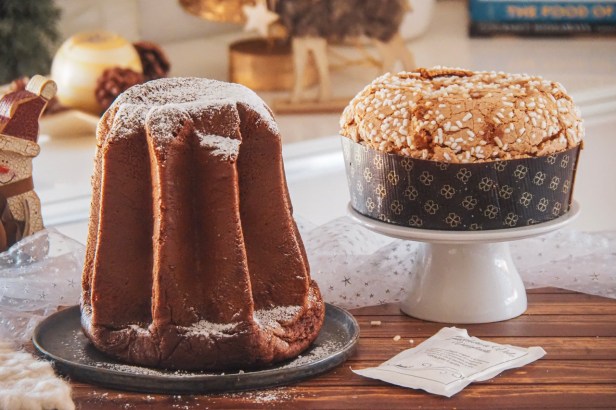
Originally from Milan (panettone) and Verona (pandoro) in northern Italy, both are now loved and sold across all of Italy, and increasingly abroad. Over time, new versions were added to the classic ones. You will now find panettone and pandoro filled with chocolate, vanilla custard, pistachio cream, and more. Those sold in supermarkets will be mostly industrial-produced, and nowhere near the traditional hand-made artisanal types. Therefore, if you ever happen to visit Italy in November or December or there is a bakery where you live you that makes artisanal panettone and/or pandoro (thankfully, you can find them now in many parts of the world), make sure not to miss the opportunity to get a firsthand taste of these delicious Christmas treats. They are more costly, but believe me, you will be in for a treat.
In Italy, it is usually either panettone and pandoro; and the discussion which one is better is a very heated one. Sometimes even dividing families. For a former expat living in Italy, thankfully I never had that issue. Offer me a panettone, and I am happy. Offer me a pandoro, and I will be happy too.
An introduction to Panettone and Pandoro: What are they, and what is the difference of the two
You could think panettone and pandoro are part of the same family as they look remotely similar. In fact, they have several ingredients in common but in the end are two very different sweets.
Traditional Italian panettone is prepared with plump raisins and candid fruits and comes in a dome-like shape. Meanwhile the classic pandoro distinguishes itself by its tall, star-shaped size, and a softer, lighter texture without any fillings.
What is Panettone
Panettone literally means ‘big bread’ in Italian. It is a soft, finely textured sweet dough filled with candid fruits and sultana raisins.
While the first sweet breads prepared for Christmas were prepared as early as the 15th century in Milan and likely northern Italy, panettone as it’s known today origins in the 19th century. At the time, confectioner Giovanni Felice Luraschi decided to add yeast to a sweet bread he was preparing to create a taller and softer cake and added cubes of candid fruit the enrich the flavour.
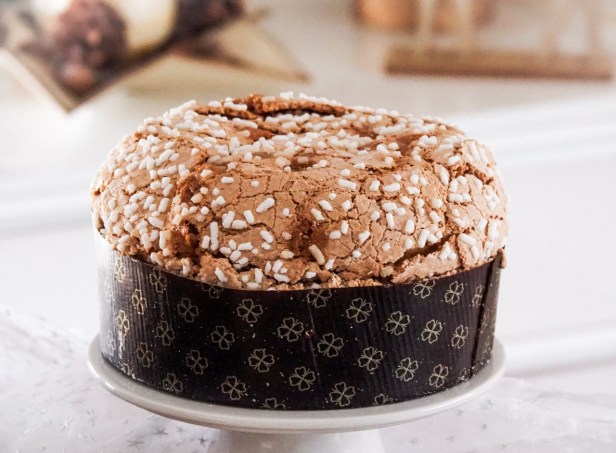
The traditional artisanal panettone is made from enriched dough, which means eggs, sugar, milk, and/or butter are added. To create the level of softness and texture required, ‘lieveto madre’ a sourdough starter is used for the dough, which is then set aside to rise for two full days. After it’s baked, it is set to rest for another day and then turned upside down to dry.
Thus, a total of three days is needed to make artisanal panettone. And this does not include the time needed to create the sourdough starter. Which explains the price of a hand-made classic panettone starting at around 30 euros.
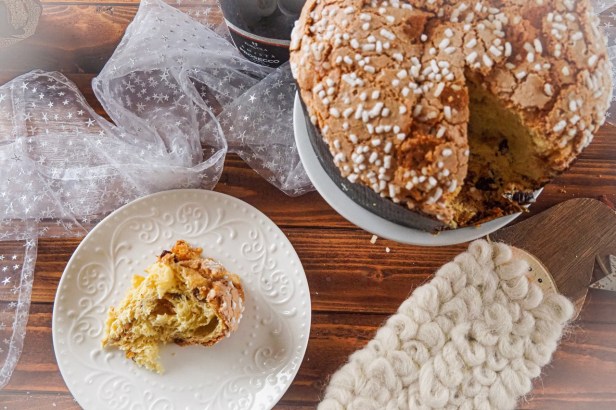
If you happen to be in Milan, check out the small local bakeries. Several will now sell panettone year-round. Have it with a cappuccino or latte macchiato for breakfast.
What is Pandoro
Pandoro originates in the city of Verona. The name comes from the Italian word pan d’oro which translates to golden bread, perfectly capturing the yellow-golden colour of pandoro thanks to the high number of egg-yolks used to make this sweet bread.
First created in the 18th century for the local aristocracy, Pandoro is traditionally baked in a star-shaped mold. The early pan d’oro was later recreated by Verona’s famous pastry chef Domenico Melegatti and today is a huge rival to the classic panettone as most popular Christmas sweet.
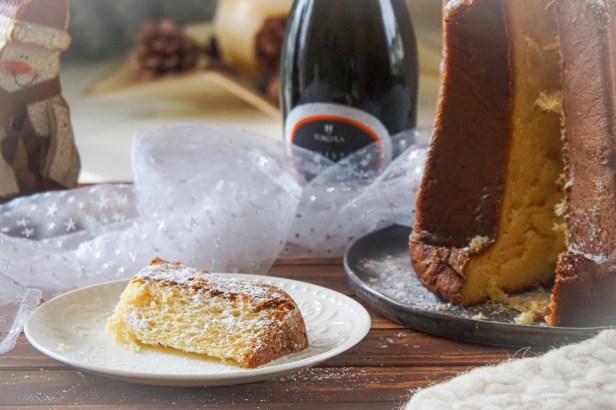
Pandoro has a soft and compact dough is soft and compact, and a smooth and velvety texture. Just before serving, it is dusted with vanilla-scented icing sugar. Thus, the cake/bread will resemble the tall snow-capped peaks of the Italian Alps. While the classic pandoro does not contain any fillings, today you will find variations filled with custard cream.
Though it might look like a simpler cake, the production process of pandoro is demanding too. It requires a double dough, at least 10 hours to rise and slowly and carefully combining the eggs and butter to create the light, fluffy golden texture.
How to serve panettone and pandoro
In Italy, both panettone and pandoro are served as dessert for Christmas in many homes. They can be served plain (or topped with iced sugar in the case of pandoro) or enjoyed with a cream of whipped mascarpone and topped with extra fruit. Often, they will be enjoyed with a glass of sweet wine like Vin Santo or Marsala, or Prosecco.
Italians also love both for breakfast. Washed down – or dunked in – a cappuccino or latte macchiato.
How long can you keep panettone and pandoro
You can keep artisanal panettone and pandoro for about 15 to 20 days when wrapped in a plastic bag. This will keep the flavours in place and the dough moist.
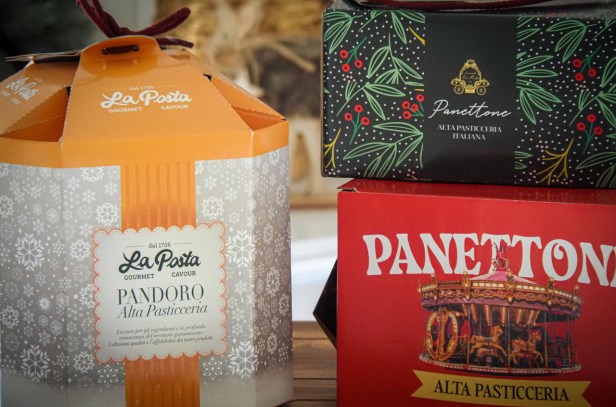
If you are new to panettone and pandoro, I can only recommend getting started. These traditional Italian Christmas sweets will quickly become two of your favourite treats during the festive season, either as dessert or for breakfast.
 Carrots and Tigers