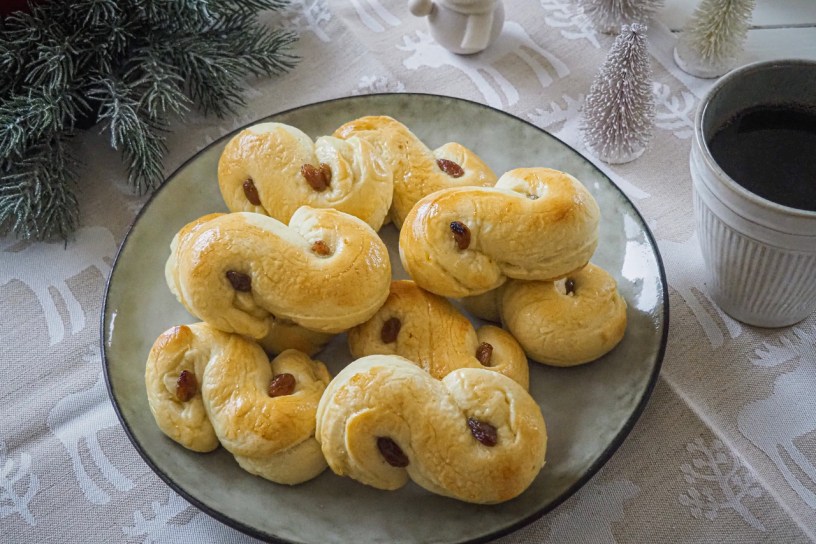
Today I am sharing the authentic recipe for Swedish Lussekatter, sweet saffron buns, and the story of Saint Lucia.
No trip to Sweden is complete without devouring the incredibly delicious cinnamon buns, called kanelbullar in Swedish, one of the most classic local sweets, and today famous beyond the Scandinavian boarders.
While kanelbullar are popular all year round, come December this popular treat is facing significant competition from the delicious lussekatter. These soft, slightly sweet saffron buns were historically eaten on St. Lucia’s Day on December 13th but are today popular during the whole Christmas period.
The meaning and how Luciadagen (Saint Lucia Day) is celebrated in Sweden
In Sweden, St. Lucia’s Day, dedicated to Saint Lucia, the patron saint of light, is celebrated on December 13th. Legend has it that Saint Lucia was a young woman who secretly brought food to persecuted Christians hiding in Roman catacombs under the city. She would light her way with candles placed in a wreath put on her head to allow her to carry food with both her hands.
Historically December 13th in Sweden had also another meaning. Prior to the Georgian calendar, that day would mark the Winter Solstice, and thus be the shortest day of the year. In ancient times, the longest night of the year was believed to be dangerous due to evil spirits plaguing the streets. For this reason, people would stay awake, and to not fall asleep, they would eat.
Today, St. Lucia’s Day celebrations in Sweden include street processions led by a young girl wearing a full-length white gown with a red ribbon around the waist and a wreath with candles on her head. She will be followed by handmaidens also wearing white gowns and red ribbons, and a wreath with glitter but no candles, while star boys will be glad in a similar fashion albeit wearing cone-like hats and carry sticks with stars. They all will sing the traditional song dedicated to the patron saint.
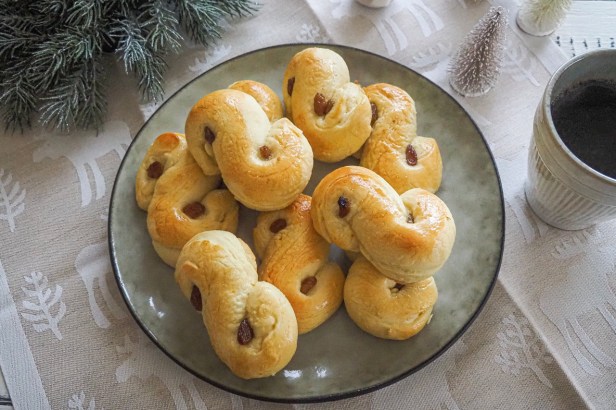
Off course, celebrating St. Lucia’s Day would not be complete without food. While a lot of gingerbread cookies will be devoured on St. Lucia’s Day as well, the most popular sweet and the one that has become synonymous with the day are the classic Swedish saffron buns lussekatter.
It’s also a Swedish tradition that on December 13th the oldest daughter, wearing the traditional white robe adorned with a red ribbon, will serve these delicious sweets for breakfast. However, today they will be devoured the whole day and come afternoon, coffee will be replaced by a glass (or more) of glögg, the local version of mulled wine.
How to make Lussekatter, the traditional Swedish saffron buns eaten on St. Lucia’s Day
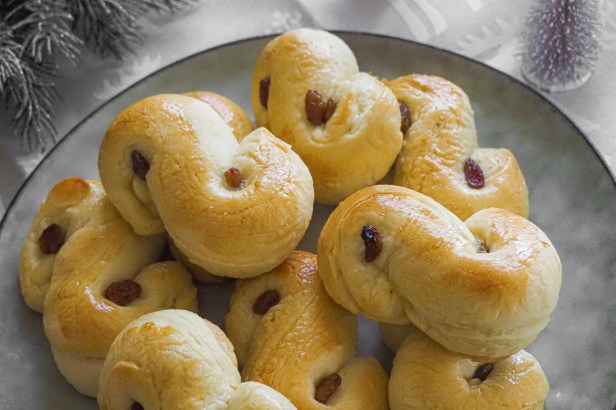
The sweet, saffron-flavoured little buns shaped like an ‘S’ are also said to look like a cat that’s curled up, with the raisings being the cats’ eyes.
The buns are easy to make, but you need some patience since the authentic Swedish recipe requires the dough to rise several times.
Makes 35 pieces
For the starter dough
50 g fresh yeast (alternatively, 7 g instant yeast)
250 ml whole milk at room temperature
100 g sugar
350 g all-purpose flour
For the main dough
250 ml whole milk at room temperature
150 g sugar
200 g butter
1 teaspoon salt
750 g all-purpose flour
1 egg
1.5 g saffron
Raisins for decorating (optional)
Method
For the starter dough, add fresh yeast and milk to a food processor. Dissolve the yeast at low speed. Add sugar and flour and knead until opting an elastic dough, for about 5 minutes. If you use instant yeast, add all ingredients at once and proceed as above.
Cover the starter dough with a kitchen towel and set aside at room temperature for around 30 minutes to let rise to double size.
Melt the butter in a small saucepan over medium heat. Add the saffron and fry for a minute. Set aside and let cool shortly.
Add the butter-saffron mix to the starter dough together with the remaining ingredients. Knead the dough for about 10 minutes in the food processor until elastic and yellow.
Roll the dough into a large ball and cut off small pieces of approximately 70 g. Roll into small balls and place on a baking sheet lined with parchment paper. Cover with a kitchen towel and set aside until the balls have doubled in size.
On a working surface, roll the balls into a snake about 15 cm long. Curl the ends in opposite directions, one to the left and one to the right, forming an ‘S’. Place 1 to 2 raisins in the middle of the curls.
Place the lussekatter on a baking sheet lined with parchment paper and let them rest in a cool place (either a cold basement or the fridge) for about one hour. Return to room temperature and let rise until the buns have almost doubled in size.
Preheat the oven at 220°C.
Brush the buns with the lightly whipped egg.
Bake for about 10 minutes until the lussekatter take on a light golden-brown colour.
Serve straight from the oven or let cool first.
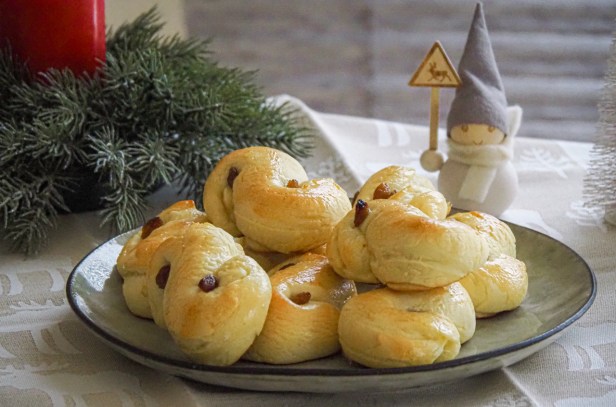
If you want to make ahead, the best way to conserve the buns is putting them into the freezer. To defrost them, put them in the oven again.
Enjoy.
 Carrots and Tigers