
Move aside Tagliatelle al Ragù. During carnival, the sweet version with sugar and orange zest is taking over in Italy’s Emilia-Romagna.
Did you know carnival likely originated in Italy?
Although the origins of the festival are not completely clear, there are sources that suggest it goes back to the ancient Roman Saturnalia festival. This pagan festival was celebrated in mid-December, honouring god Saturn, the father of Jupiter.
Later, during the Middle-Ages the reigning pope would travel to Rome’s Monte Testaccio on horseback to chair a local competition of local noble families including bullfights, contests, and other competitions. The event was known as ludus carnevalarii. Around two centuries later, Pope Paul II turned the event into an 8-day event staging animal races, and races of different groups of people like children, and elderly. Known as Renaissance Carnival, it took place in Rome’s Via Lata, which was eventually renamed Via del Corso, the street of the races.
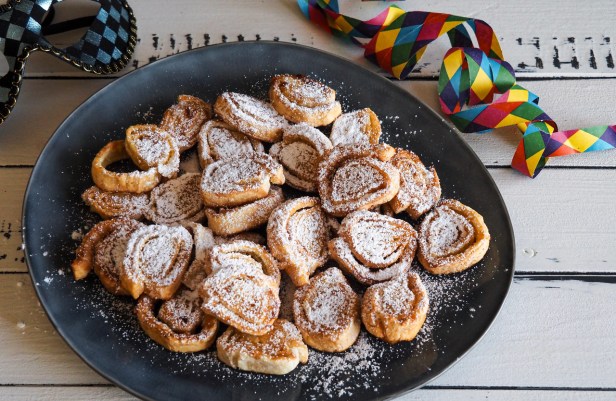
Now, this certainly sounds a lot like today’s carnival processions including processions and dancing through the streets. And while the most famous carnival celebrations are no longer taking place in Italy – with destinations like Rio de Janeiro and New Orleans topping the list of carnival hotspots – during the four weeks running up to Shrove Tuesday, the Italian Peninsula is still home to many local carnival celebrations.
Beyond the most famous, Carnevale di Venezia, from north to south, numerous local festivities are hold taking place each year. All of them have their own angles, like the famous Battle of Oranges in the town of Ivrea, Piemonte on Shrove Tuesday.
There is one thing they have in common: food.
Which is perhaps not surprising. After all, this is Italy.
What are Tagliatelle di Carnevale
Tagliatelle di Carnevale are popular canival sweets in the Emilia-Romagna region. The area stands from some of the internationally most famous foods from Italy, including Parmigiano Reggiano, Parma Ham, mortadella, balsamic vinegar of Modena, tortellini and indeed tagliatelle.
Tagliatelle are flat, long ribbons of pasta made with flour and eggs. The most famous dish involving this type of past without any doubt are Tagliatelle al Ragù.

During the carnival season, tagliatelle di Carnevale, the sweet version of tagliatelle can be found everywhere in Emilia-Romagna.
Also referred to as Tagliatelle Dolci di Carnevale (dolci means sweet in Italian), these popular sweets are made with the original tagliatelle pasta dough. The dough is thinly rolled out and covered with granulated sugar and orange zest. It is then rolled up and cut into pieces which are deep fried until golden and crispy.
How to make Tagliatelle Dolce di Carnevale, the popular carnival sweets from Italy’s Emilia-Romagna
The recipe for the sweet tagliatelle is one of the easiest and quickest of all the various carnival sweets popular in Italy I have come across of so far.
For a grown-up version, substitute the large eggs with medium-sized eggs and add a splash of rum.

200 g all-purpose flour
2 large eggs
pinch of salt
60 g granulated sugar
zest of one orange
sunflower oil for frying
Sieve the flour into a bowl. Using a fork, mix in the eggs until well blended then knead into a homogenous dough.
Form into a ball, wrap in plastic and refrigerate for 30 minutes.
On a slightly floured work surface, roll out the dough into a rectangle about 2mm thin.
Sprinkle the dough with granulated sugar and orange zest.
Roll up the dough long side to long side. Wrap in plastic and refrigerate for another 30 minutes.
Cut the dough in small slices 1cm thick.
Heat sunflower oil in a medium sized pot to around 170°C. Fry the rolls in batches (don’t overcrowd the pot) until golden brown.
Transfer to a rag to let drain the excess oil.
Cover with powdered sugar.
Serve while still warm.
 Carrots and Tigers