
The capital city of Portugal’s Alentejo region is an unmissable medieval gem. Here is all you need to know to plan your visit.
Évora, the capital of Portugal’s rural Alentejo region, is located around 130 kilometres east of Lisbon. The city was founded by the Romans, then conquered and fortified by the Moorish, and in the 15th century became the residence of the Portuguese kings. Which made the city one of the most important and influential during the Middle Ages and set the cornerstones of its rich cultural history still visible today.
The historic core of Évora, still partly enclosed by medieval walls, boasts a mixture of Roman, Moorish, Gothic, and Baroque architecture. Among the many historic monuments and sites are the massive cathedral, many churches, convents, and old palaces lining beautiful squares and small cobble stoned streets. No wonder the city was added to UNESCO’s World Heritage list in 1986 and declared ‘museum-city’.

With that pedigree, there was no question Évora would be one of the stops during my road trip through the amazing Alentejo region. Sandwiched between Lisbon and the Algarve in the south, this southeastern part of Portugal covers roughly one third of the total national territory. However, the largely rural region is still one of the lesser visited. Except for its capital city, Évora, which has become a popular daytrip destination from Lisbon.
If you are unfamiliar with the Alentejo and wonder if the region is worth a trip, read my post 6 fantastic reasons to visit the Alentejo in Portugal.
So, are you planning a day trip to Évora, or perhaps a longer stay venturing into the wider Alentejo region? Then this guide will help you to plan an unforgettable visit, whether you come on a daytrip or base yourself in the city or nearby countryside for a few days.
Below, I have put together the main attractions not to be missed along with additional suggestions what to do beyond exploring the city’s rich history.
Exploring Évora’s main attractions and what else to do in the capital of Alentejo, Portugal
The UNESCO listed historic core of Évora is home to many exciting monuments and historic buildings lining small cobble-stoned streets and squares, and thanks to the small size perfectly walkable with the main attractions easily explored in a day.
Start your visit at the highest point of the town, at the site of the imposing cathedral, then work your way around town exploring the main monument and lovely small streets.
Cathedral of Évora
The building nestled at the highest point of Évora is the largest medieval cathedral in all of Portugal, and well visible from almost every point in the city and far away.
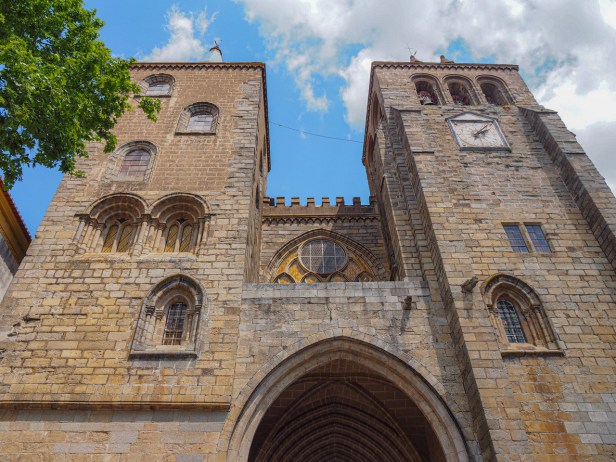
The imposing cathedral is officially named Nossa Senhora da Assunção – Basilica Cathedral of Our Lady of Assumption while locally it’s referred to as Sé de Évora. Construction of this massive Gothic structure begun in the late 12th century and finished in the middle of the 13th century. However further work on the structure was done during the 15th and 16th centuries and the main chapel sponsored by King Joao V was added in the 18th century.
Roman Temple and Jardim Diana
Just a few steps from the Cathedral, you can find the remains of the Roman Temple, also known as the temple of Diana. Perhaps the most iconic image when thinking of Évora are the remains of the Roman temple, also known as the temple of Diana. It was built in the 1st century and today is the best-preserved Roman temple across the whole Iberian Peninsula.
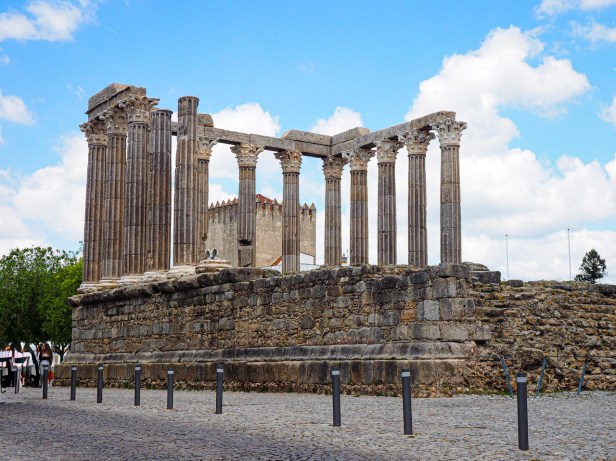
Once you have circled this stunning example of Roman architecture, grab a drink at the nearby kiosk and head to Jardim Diana just opposite of the temple. Here you can sit down to take in the sight of the temple and surrounding square.

Before you leave the little park, don’t miss to turn around to take in the stunning view over the sprawling white houses and roofs of Évora.
Igreja dos Lóios – Church of the Lóios
Next to the Roman temple also sits the Church of the Lóios. Inside, it’s decorated with the famous Portuguese blue and white Azulejo tiles.
Originally built to be the resting place of D. Rodrigo Afonso de Melo, the first Count of Olivença and his family in 1485, the beautiful church was part of a convent that is now privately owned and turned into a Pousada hotel.
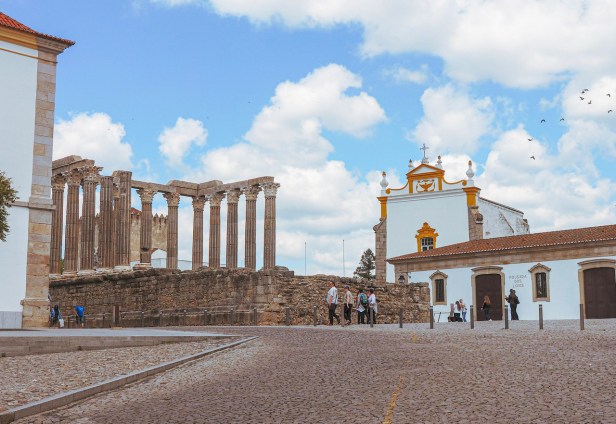
The Pousada is still connected to the adjacent Cadaval Palace, and aristocratic residence that is partly open to visitors for temporary exhibitions.
Praça do Giraldo – Giraldo Square
Now it’s time to head towards Évora’s main square, Praça do Giraldo which is also the busiest (and most touristy) part of the city.
The square takes its name from Geraldo Geraldes, who in 1167 conquered Évora from its Moorish rulers. He later became Governor of Évora and High Protector of the Borders of Alentejo by orders of King Afonso Henriques, the first king of Portugal.
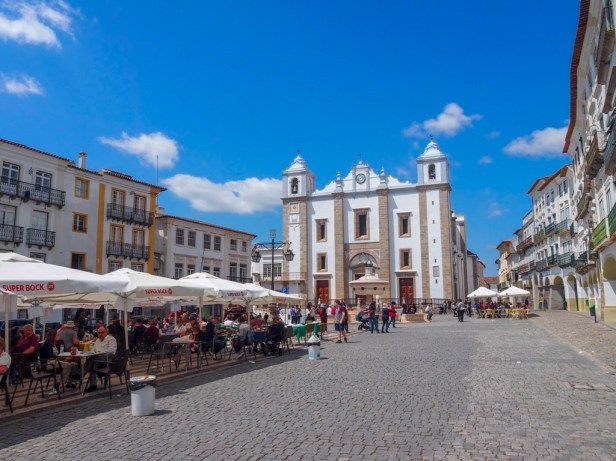
Located at the very heart of Évora, the large quare is lined by cafes, restaurants and shops. Have a coffee and, in case you are visiting later in the day, a cocktail. Though, if you are looking for lunch or dinner, I would recommend finding a less touristy spot.
Igreja de Santo Antão – Church of St. Antão
At the northern end of Giraldo Square towners the Church of St. Antão. Dating back to 1557, the beautiful Renaissance building replaces an old chapel dedicated to St. Antoniy the Great. The structure featuring a bell towner on each side of the building and three Mannerist portals has become a model for many other churches across Alentejo.

The church was built by orders of King Alfonso Henriques, and construction of the church also led to the creation of Giraldo Square as we see it today because the historic monuments previously occupying the square were destroyed as they blocked the view towards the church.
Directly in front of the church you will find the famous marble fountain dating to the 16th century. It is adorned by eight spouts, representing the eight main streets leading to Giraldo Square.
Igreja Real de São Francisco – The Church of St. Francis
At the southern end of Giraldo Square, turn into Rue da Republica towards the Church of St. Francis. This is one of the most famous landmarks of the city, build during the late 15th and early 16th centuries. It’s perhaps best known for the rather spooky bone chapel.
Capela dos Ossos – Bone Chapel
Just next to the entrance of the Church of St. Francis, you will find the famous bone chapel. Built during the 16th century from around 5,000 bodies exhumed from the city’s graveyards. If that is not already reason enough to feal a chill down your spine, the limited light insight makes the visit even more chilling.
Aqueduto da Água de Prata – Agua de Prata Aqueduct
Just outside of town, the old aqueduct designed by Francisco de Arruda (who by the way was also responsible for the design of Belem Tower in Lisbon) was completed in 1530. The construction once brought water from more than nine kilometres away to the city.

Today, the aqueduct still stretches several kilometres outside of town. However, don’t miss the part build into the historic part of Évora where the historic houses were built right into the arches.
Explore the museums and exhibition spots
If you have still time to spare, don’t miss some of the most interesting museums and exhibition spots. The Museu de Évora – Évora Museum displays a permanent exhibition of archaeology, art and artefacts of the convents of Évora. In addition, there are temporary exhibitions covering a wide range of topics. Meanwhile Fundação Eugénio de Almeida – Eugénio de Almeida Foundation is home to temporary exhibitions including contemporary art, painting and photography.
Shop local handicraft
Évora’s squares and small alleys are lined with equally small shops offering all sorts of items. Make a point to look for traditional handicrafts of the Alentejo made of clay, iron, cork, leather and horn.

Once a hotspot of artisan shops, Rua 5 de Outubro (Street of 5th October) connecting Giraldo Square with the Cathedral still hosts various shops selling local handicraft and souvenirs.
Enjoy the Alentejo cuisine, and of course the local wines!
While I did not have lunch or dinner directly in Évora, the city offers a wide range of restaurants where you can enjoy the local Alentejo cuisine and above all the excellent local wines.
If you are planning to venture into the wider Alentejo region to enjoy local food and wines, then check out my post Your perfect starter guide to wine tasting in Alentejo. It is really just a starting point on some of the leading wineries, with the list of excellent local wineries much longer. However, one must start somewhere, and these wineries will not disappoint.
Is Évora worth a daytrip?
Évora is a beautiful city totally worth being explored. That said, would I recommend a daytrip? That depends.
If you are visiting Lisbon and have a couple of days planned for your trip, you might consider visiting Évora on a daytrip from Lisbon. Well, the good news is that there are excellent connections both by bus and train, and ticket prices are fairly low for both options.
However, whether you take the bus, train or perhaps travel with your own car, it will take you around 90 minutes for one way. Which is not bad at all, although a daytrip to Évora from Lisbon means you will arrive mid to late morning and need to leave mid-afternoon to cover the distance. While you can explore the city’s main attractions in a few hours, if your visit is taking place during peak season (from around late May through September), this means you will arrive when the number of visitors is at the highest.

If your visit takes place during the early part of spring or late autumn, or perhaps during the winter months, then you will have more of the city to yourself. Though winter means that you will at least spend the time travelling to and from Évora in the dark.
If the above does not bother you, a daytrip to Évora is more than worth it.
That said, with plenty of explore, and the fantastic local Alentejo cuisine and wines, I recommend planning more time visiting Évora and the surrounding Alentejo. The city is located more or less in the middle of the Alentejo, which makes it the perfect place from where to explore the region.
If you are planning to venture into the wider Alentejo region to enjoy local food, and above all, the excellent local wines? Then check out my post Your perfect starter guide to wine tasting in Alentejo. It is really just a starting point on some of the leading wineries, with the list of excellent local wineries much longer. However, one must start somewhere, and these wineries will not disappoint.
How to get to Évora
Évora is located around 130 kilometres to the east of Lisbon, which Lisbon the nearest international airport.
If you are planning to visit Évora on a day trip from Lisbon, your best option is taking either the express bus or train, which both depart from Lisbon Sete Rios station and take about 90 minutes to arrive.
Meanwhile driving to Évora from Lisbon will also take around 90 minutes, and once you have left the wider Lisbon area traffic will likely be thin.
If you are planning to see more of Alentejo, the best option to arrive is by car since public transport is quite limited outside Évora.
What is the best time to visit Évora
Portugal’s Alentejo region might still be one of the lesser-known areas, but the region’s beautiful capital city has evolved into a popular destination for visitors on a daytrip from Lisbon.

Early or late shoulder season, thus early spring or late fall typically offers sunny weather while tourist crowds are still much thinner. Otherwise, April to early June and September through October usually means warm and sunny days.
Summer months will not only bring lots of tourists to the city, but temperatures can climb well above 30°C during July and August.
Winter is usually mild, but nights can get fairly cold, and rainfall is typically highest during the winter.
Where to stay in Évora
If you plan to stay overnight or even longer, there is plenty of accommodation within or near Évora.
Hotel Convento de Évora – Also referred to as Pousada dos Loisos, this 5-star hotel is located right in the heart of Évora UNESCO site. It sits right next to the iconic Roman Temple in a former convent. Here you will sleep in the old monk cells which have been turned into hotel rooms.

Convento do Espinheiro – Just a few kilometres outside of Évora sits a 15th century convent turned 5-star luxury hotel. In 1490 Princess Isabel, the oldest daughter of the Spanish king, spend the night before her wedding to Crown Prince Afonso of Portugal at the convent, while today it is a popular spot for weddings. The hotel perfectly combines history with modern luxury, including a beautiful park-like garden with a large pool perfect to wind down and relax after a day exploring the historic sights of nearby Évora.
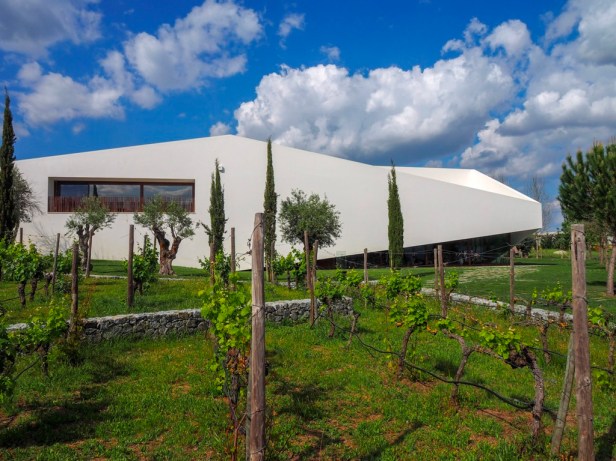
L’AND Vineyards – Located round about 30 minutes from Évora, at Montemor-o-Novo you will find one of the most intriguing vineyard hotels of the Alentejo. The 5-star hotel is surrounded by 7,000 hectares of vines and boasts both showstopping architecture along with the Michelin-starred restaurant.
Final Thoughts
If Évora, the capital of Portugal’s Alentejo region is not yet on your travel bucket list, I highly recommend changing this immediately.

The UNESCO listed historic city has just been named European Capital of Culture 2027, and for a reason. The small city is a real stunner and perfect to be explored on a daytrip, as stopover on a road trip through the Alentejo, or as your main base to venture into the rural countryside of this under-the-radar (wine) region.
 Carrots and Tigers